
By Muhammad Noza Abdullah
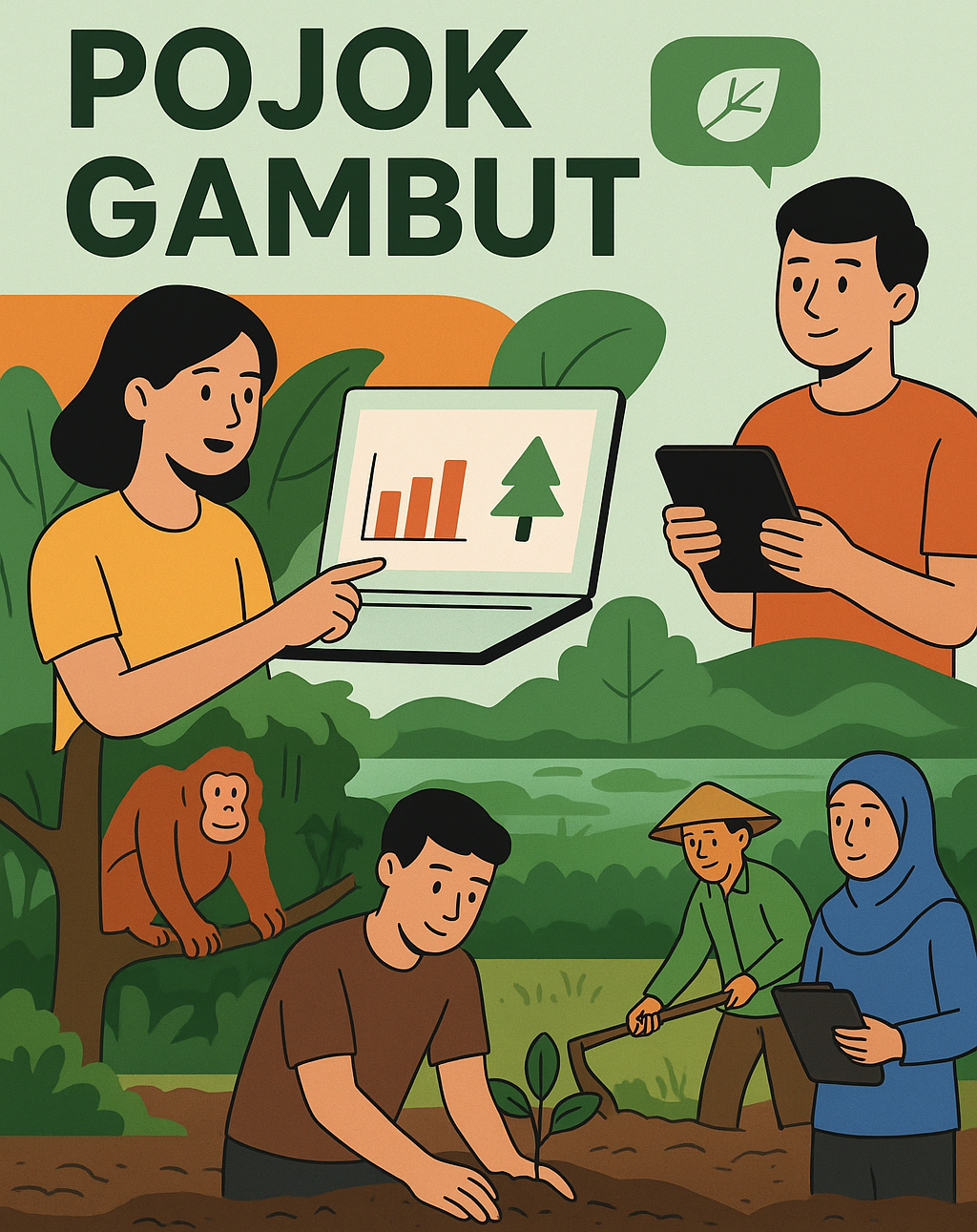 In western Aceh, peatlands are more than just wet, dark landscapes. They are living spaces, sources of livelihood, and the last line of defense against the climate crisis. Amid increasingly extreme weather changes, the voices of residents who live side by side with the peatlands need to reach a wider audience. Here, digital technology serves as a bridge of knowledge, and the Pojok Gambut (Peat Corner) community emerges as a learning space that curates stories, photos, and videos through a form of journalism that sides with ecosystem safety and community well-being. The Pojok Gambut website is managed by Basajan.net with the goal of raising awareness about peatland protection in the context of emission reduction and community welfare. It presents information in the form of news features and in-depth reporting based on direct field coverage—credible educational material in the digital space.
Pojok Gambut did not appear out of nowhere. It grew from real local issues, such as in Rawa Tripa, which stretches across Nagan Raya Regency. There, Pojok Gambut documents stories of residents becoming more aware of the importance of peatland conservation and promoting alternative crops—proof that behavioral transformation can be built through continuous knowledge sharing. The coverage of Rawa Tripa also highlights its protected biodiversity, including orangutan habitats, reinforcing the ecological reasons for prioritizing this area’s protection. These narratives serve as essential foundations for building resilience because communities that understand the ecological function of peatlands are better prepared to respond to droughts, fires, and floods that are increasingly frequent due to climate change.
The experience in Darul Makmur District provides a concrete example of how community-based education and digital media can strengthen adaptation. Through coverage of Sumber Bakti Village in Darul Makmur, Pojok Gambut showcases the economic potential of water and garden-based livelihoods while highlighting local role models who successfully cultivate crops other than palm oil. These stories are not just good news—they are educational tools that shape public opinion about climate-resilient livelihoods. When residents see successful practices discussed in digital spaces, the adoption of innovation accelerates.
The main strength of digital technology lies in its ability to expand reach while maintaining storytelling depth. Pojok Gambut combines both through accessible and shareable formats—from in-depth reports to photos and videos. This combination enables young people to become knowledge producers, not merely consumers. They learn to analyze data, interview sources, capture meaningful images, and craft stories that inspire action. The foundation is clear: Pojok Gambut’s mission to raise awareness and encourage behavior change based on field evidence.
The role of youth is especially visible in the “Kisah Mereka” (Their Stories) section, which highlights the dedication of young Acehnese peatland defenders. This representation is vital—it transforms conservation from being seen as the work of a few into an inclusive social movement. When young people and students take the lead in education, the language becomes more relatable, down-to-earth, and easy to understand. Youth skillfully integrate website content with social media channels, using mobile devices to create short videos, invite public participation in online classes, and develop community-based early fire warning systems. The foundation for all this is a network of young activists forged through continuous engagement.
Beyond ecological knowledge, digital education also strengthens local economic resilience. Pojok Gambut’s coverage often features opportunities for business diversification on peatlands, including non-timber commodities such as ginger cultivation on peatland and catfish farming as a community income source in Seuneuam. Such content can be turned into short modules and infographics guiding climate-smart farming practices. When narratives are linked to market networks and entrepreneurship communities, digital technology helps small business owners find buyers, share experiences, and better calculate risks. This aligns perfectly with the platform’s mission to connect field knowledge with community welfare improvement.
In terms of governance, digital technology enhances transparency and accountability. Well-organized and open documentation fosters healthy dialogue between citizens, civil society organizations, and the government. Pojok Gambut often voices calls for Aceh to become a priority region for peatland restoration—a policy agenda that requires public legitimacy. When policy discourse is enriched by data, field stories, and community voices, public decisions tend to be more responsive to frontline needs.
To amplify educational impact, there are three strategies that Nagan Raya youth can strengthen to support Pojok Gambut’s work.
First, develop climate literacy programs that combine in-person village classes with open learning materials on the website. Modules can be thematic—ranging from fire prevention and water management to occupational safety during wildfires—and should be linked to Pojok Gambut’s coverage archives to show their local relevance.
Second, establish a community content lab that trains youth as contributors, ensuring that stories from remote areas do not remain oral traditions but become verifiable public records. The “Kisah Mereka” section offers a role model for this approach.
Third, foster partnerships with schools, Islamic boarding schools (pesantren), and MSMEs so that adaptation practices become part of learning and enterprise—not one-time projects. These efforts will enhance adoption and sustainability because they are embedded in trusted community institutions.
The digital ecosystem also connects local communities with national networks. Through news channels and peatland activist networks, Pojok Gambut reports on conservation and monitoring movements in other regions. This connectivity enables knowledge exchange—from rewetting technologies to low-emission economic innovations. When interregional learning becomes open and documented, community adaptive capacity grows without waiting for large external programs.
Ultimately, community resilience in the era of the climate crisis rests on two pillars: accessible knowledge and organized solidarity. Pojok Gambut offers both, supported by a website that features on-the-ground reporting, visual documentation, and youth storytelling spaces. Nagan Raya has already provided many stories of how its residents refuse to give in to despair, weaving hope from fragile wetlands. Our task is to ensure those stories reach more ears and hands—so that adaptation becomes more than a slogan, but a living practice that strengthens everyday life. Digital technology provides the path, communities fortify the steps, and youth serve as the pillars keeping knowledge alive amid rapid change.