
By Minda Rahayu Khairi, S.Pd. Gr
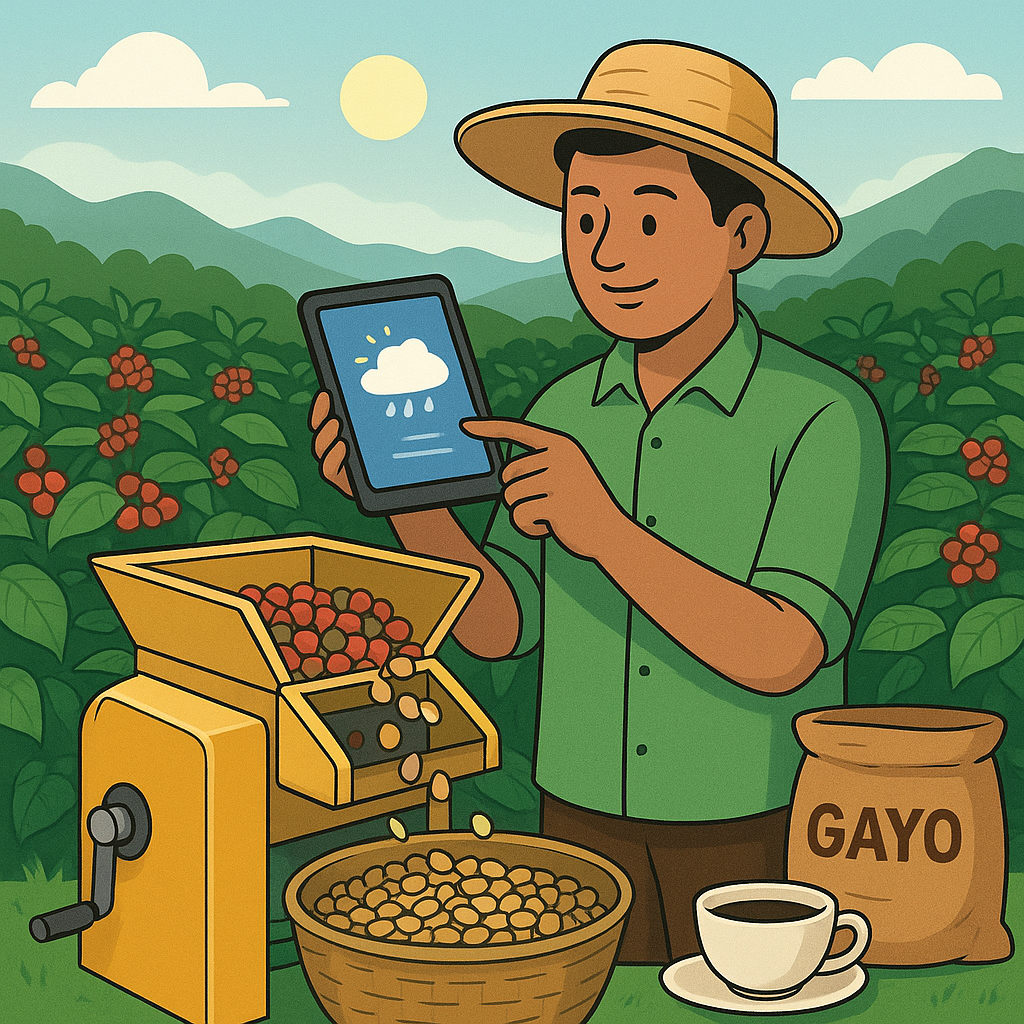
On the cool slopes of Gayo Lues, Aceh, coffee is more than just a plant—it is heritage, cultural pride, and a source of livelihood for the community. However, in recent years, coffee farmers have faced various challenges: extreme weather, fluctuating prices, and increasing market competition. Amid these circumstances, several farmers have begun to innovate by utilizing post-harvest coffee processing technology to survive and grow.
I am one of the Arabica and Robusta coffee farmers in Blangpegayon District. I used to sell coffee in cherry form (fresh coffee fruit) to local collectors at low prices. But since joining a farmers’ group, an NGO, and attending coffee processing training, I started processing my own harvest using simple technology such as a pulper machine (coffee skin peeler).
Gayo Lues farmers also use digital agriculture applications that provide daily weather forecasts, humidity levels, and rainfall potential in the area. This information helps determine the right time for planting, fertilizing, and pest control to minimize crop failure caused by extreme weather.
“We didn’t understand before why our coffee was often offered at a low price. It turns out post-harvest quality has a huge impact on pricing. Now, with this technology, I can sort the beans, dry them evenly, and as a result, our coffee is rated higher in quality by buyers.”
Now, I apply the full wash and honey process methods using a controlled fermentation system. I also use a digital moisture meter to ensure the coffee’s moisture content stays below export standards (12%). For dried beans, this proper moisture level is crucial to prevent mold growth and maintain the taste and aroma of the coffee without over-drying. For ground coffee, the maximum moisture content standard is 7%. In addition, I use social media to market my coffee directly to buyers, even receiving orders from cafés in Medan and Jakarta, and I create YouTube content to promote my coffee and increase my income.
Not stopping there, my farmers’ group also uses a small roasting machine to produce ready-to-brew ground coffee. They created their own local brand and sell it in tourist markets and Acehnese souvenir shops. With this added value, farmers’ incomes have increased, and they are no longer entirely dependent on middlemen.
The local government and cooperatives also support us by providing shared processing facilities, cupping (taste testing) training, and small-scale roasting machine assistance. This opens opportunities for young Gayo Lues farmers to see that coffee farming is not just traditional work but a business venture with global market potential.
The “Gayo Coffee Festival” and “Cup of Excellence (COE)” are coffee events held in the Gayo region. In these events, the Gayo Lues community organizes competitions such as cupping (taste testing), manual brewing, and latte art. One of the goals is to ensure this cultural heritage never fades and that the Gayo Lues community remains enthusiastic about participating.
“In the past, we were just farmers. Now we are also small entrepreneurs. From planting to packaging, we manage everything ourselves. Technology has changed the way we see coffee.”
Today, Gayo Lues coffee—especially the Arabica variety—is renowned for its smooth and complex flavor profile, with low acidity and a subtle spicy aroma. Originating from the Gayo highlands, it is considered one of the premium coffees not only in Indonesia but also worldwide.
For me, coffee is not just about taste—it is the core of life that brought me to university, gave me broad knowledge, and allowed me to meet my daily needs. I only wish to continue this legacy, hoping that coffee and culture will always move forward together from generation to generation.
Amid global challenges and unpredictable climates, Gayo Lues coffee farmers have proven that with a spirit of learning and the use of technology, they are not only able to survive but also to rise and compete in a wider market.