
By Randi Syafutra
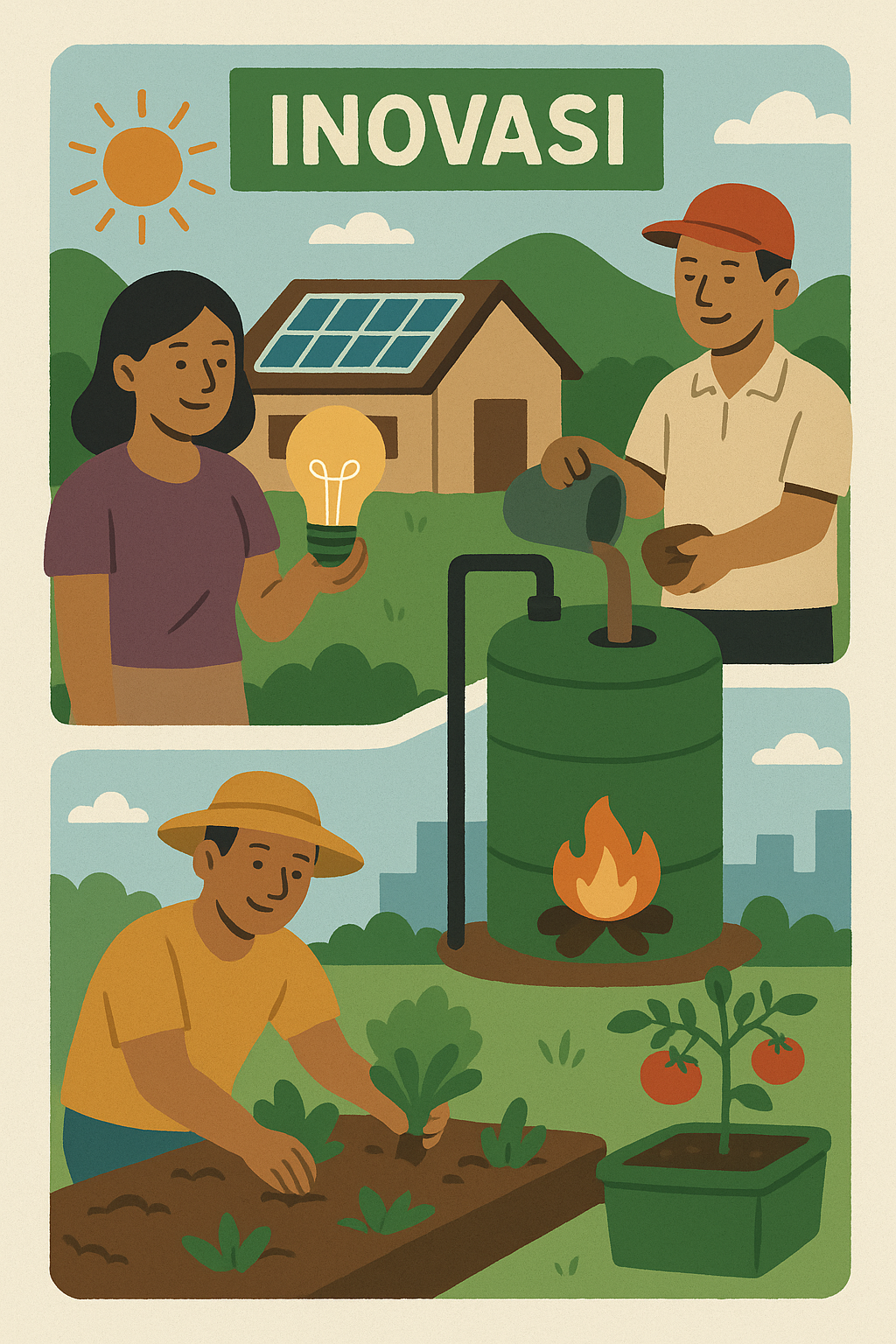
In many corners of the country, the word “innovation” often sounds grand, yet feels distant from everyday life. It is frequently portrayed as something born in air-conditioned rooms, supported by costly research, and only accessible to big cities. Yet the long history of this nation shows that the ability to innovate actually grows from simple daily needs and a closeness to nature. Indonesia has flourished through the creativity of its people who face limitations head-on — and from those limitations, wisdom emerges to keep life going. Now, as the world faces a climate crisis, energy shortages, and the piling problem of waste, we need to once again turn to the power of local green innovations — small community ideas to address big problems.
The recent energy crisis in Kalimantan serves as a real example of how dependence on a centralized power system can disrupt public life. Long blackouts didn’t just darken homes but also affected hospitals and people’s livelihoods. At the same time, Jakarta faced a waste management crisis when operations at the Bantargebang landfill were disrupted. Mountains of unmanaged garbage created not just an odor of crisis but also a reminder that even major cities can collapse without a strong circular system. Ironically, in small villages, people have found ways to light their homes and care for the environment using simple technologies they manage themselves.
Take the example of Kasepuhan Gelar Alam Village in Banten. By building a micro-hydro system from a nearby river, they brought clean electricity to 150 homes — without waiting for massive government projects or foreign investors. Elsewhere, communities have pioneered biogas systems from livestock waste, which not only generate energy but also enrich the soil. These innovations were not born from consultant meetings, but from daily needs — how to keep the lights on and the kitchen running without buying gas or burning wood. This is the strength of local green innovation: born from real needs, using available resources, and managed collectively.
We actually live in a paradox. On one hand, the government promotes its Net Zero Emission target for 2060 with renewable energy slogans. On the other, in many villages, communities have already been living low-carbon lifestyles through simple, practical means rarely featured in headlines. Big narratives often overshadow small voices — yet it is those small voices that offer clear direction for a sustainable future.
Consider the issue of waste. Jakarta produces about seven thousand tons of garbage every day, most of which ends up in Bantargebang. When the facility is disrupted, the whole system seems to collapse. Compare that with villages in Central Java or Bali that have built community-based waste banks. By involving households, they sort waste at its source, turn organic materials into compost, and sell non-organics for recycling. This simple program not only creates a new local economy but also reduces the burden on landfills. What big cities fail to manage, small villages are solving. It’s not the sophistication of technology that matters — it’s social commitment.
Environmentally friendly technology doesn’t always mean expensive solar panels or giant wind turbines. It can be green roofing tiles that cool homes, bricks made from plastic waste, or simple composters in backyards. There are even kinetic tiles that absorb the energy of footsteps — an experiment now being tested in public spaces around the world. All this proves that green innovation doesn’t belong to a privileged few; it can take root anywhere there’s a will to share knowledge.
However, the road to strengthening local innovation is not always smooth. The biggest challenge is sustainability. Many projects start with great enthusiasm but fade once funding stops. This is where the government’s role becomes crucial. It should not only act as a regulator or provider of mega-projects, but also as a facilitator that nurtures small initiatives so they can grow into large movements. Fiscal incentives could be offered to villages developing renewable energy. Universities and research institutions need to go into the field to adapt technologies to local needs. In this way, academic knowledge meets local wisdom.
The electricity crisis in Kalimantan could serve as a turning point. Instead of merely repairing centralized grids, why not expand distributed, community-based energy? Villages with small rivers can build micro-hydro systems. Windy regions can use mini turbines. Coastal areas can develop floating solar panels. Small-scale systems may not seem spectacular to investors, but they’re far more resilient in times of disaster. If thousands of villages had their own power generators, a blackout in one area wouldn’t cripple the whole network. Decentralized energy is not just technical — it’s about sovereignty.
The same logic applies to waste. When Jakarta struggles, villages offer simple solutions. The key lies in awareness — that household waste is the responsibility of those who produce it. This model is far stronger than relying on contractors or costly incinerator projects. If cities could humbly learn from villages, perhaps we would no longer see mountains of garbage polluting our air and rivers.
Beyond energy and waste, food security also matters. The climate crisis disrupts planting patterns, while fertile lands are being consumed by extractive industries. In big cities, food prices fluctuate easily because they depend on supplies from outside regions. In this situation, urban vertical farming can be an answer. By growing vegetables on tiered racks, people can reduce carbon footprints from transport while ensuring access to fresh food. The urban farming movement flourishing in residential areas proves that solutions can emerge from the grassroots. During the Covid-19 pandemic, small gardens helped sustain families trapped by social restrictions.
At its root, everything comes down to perspective. If technology is always viewed as something big, expensive, and external, communities will remain passive recipients. But if communities are placed at the center, technology grows from the ground up — from needs — and blossoms into independence. This is the spirit that should guide Indonesia’s journey toward a green future.
Of course, not every village is ready to manage green innovation on its own. Some still struggle with education, health, or infrastructure. But that’s where solidarity is tested. The government, private sector, universities, and civil society must come together to ensure local innovations don’t walk alone. When one village builds a micro-hydro plant, another can learn. When one community successfully runs a waste bank, others can replicate it. Through collaborative networks, local self-reliance can become collective strength.
This is not a call to romanticize villages or dismiss cities. Cities remain important, but they must humbly learn from villages that practice sustainable simplicity. Cities must also open space for their residents to become producers, not just consumers. In a world facing climate crisis, sovereignty over energy, food, and the environment cannot rely solely on large, corruption-prone, or unjust projects. It must grow from the ground up — from small homes, from simple steps, from kitchens that stay warm, from lights that stay on, and from gardens that stay green.
Indonesia already has the foundation for this: a diverse ecosystem, a spirit of mutual cooperation, and a tech-savvy young generation. What’s needed now is the political courage to shift our development paradigm — away from energy-hungry, wasteful growth and toward balance that allows the Earth to breathe. If that courage emerges, local green innovation will no longer be mere rhetoric, but a realistic path toward a resilient Indonesia.
Ultimately, it all comes down to a simple question: do we want to keep relying on fragile mega-projects, or do we dare to hold on to hope through small, tangible innovations? The answer to this question will determine whether we are truly ready to face the climate crisis — or merely busy decorating international reports. The history of this nation has shown that true strength always comes from people who create with what’s in their hands. Now, it’s time to believe in that power once again.